


Views: 0 Author: Site Editor Publish Time: 2026-10-12 Origin: Site


When comparing pressure washers, buyers often focus on the PSI rating. However, pressure is only one part of cleaning performance. Water flow also affects how quickly a machine can rinse away dirt and cover a large area.
Understanding PSI vs. GPM in pressure washers helps buyers choose equipment based on the cleaning task, surface material, and available water supply. A machine with high pressure is not always the fastest option. Likewise, high water flow cannot replace the pressure needed to remove stubborn contamination.
The right balance depends on what you need to clean.
PSI stands for pounds per square inch. It measures the pressure delivered by the pressure washer.
Pressure helps loosen dirt, mud, grease, and other deposits from a surface. Higher pressure can be useful when contamination is difficult to remove. However, the correct pressure also depends on the surface material, nozzle, spray distance, and cleaning method.
Excessive pressure can damage paint, wood, siding, vehicle finishes, and other sensitive materials. Even concrete can be marked or damaged when operators use unsuitable pressure or spray techniques.
For safe operation:
Start with a wider-angle nozzle and lower pressure when cleaning an unfamiliar surface.
Test the spray on a small, inconspicuous area.
Keep the nozzle at a suitable distance from the surface.
Follow the equipment manufacturer's operating instructions.
Use appropriate cleaning chemicals when pressure alone is not suitable.
PSI should match the surface and the type of contamination. Choosing the highest available pressure is not always the best approach.
GPM stands for gallons per minute. It measures how much water a pressure washer delivers in one minute.
While pressure helps loosen contamination, water flow helps rinse away the loosened dirt. A higher flow rate can improve rinsing efficiency and help operators clean larger areas in less time, provided the pressure and cleaning accessories are suitable for the task.
GPM is especially important for:
Rinsing large concrete areas.
Washing vehicles and equipment.
Removing loose mud and surface dirt.
Cleaning large outdoor spaces.
Supporting compatible surface-cleaner attachments.
However, more flow does not automatically mean better cleaning. The machine still needs sufficient pressure for the type of dirt and surface involved.
PSI and GPM perform different but related roles.
Specification | What It Measures | Main Function |
|---|---|---|
PSI | Water pressure | Helps loosen and remove bonded dirt |
GPM | Water flow rate | Rinses away dirt and covers the cleaning area |
CU | PSI multiplied by GPM | Provides a simple output comparison |
In practical terms, PSI provides cleaning impact, while GPM supports rinsing and cleaning speed.
A pressure washer with high PSI but low GPM may deliver strong impact over a relatively small cleaning area. A machine with moderate PSI and higher GPM may rinse more efficiently across larger surfaces.
The best choice depends on the cleaning application rather than one specification alone.
Cleaning Units are commonly calculated using this formula:
CU = PSI × GPM
The result combines pressure and water flow into one figure. Buyers can use it as a basic way to compare the rated output of different pressure washers.
For example:
Machine | PSI | GPM | Cleaning Units |
|---|---|---|---|
Machine A | 3,000 | 2.0 | 6,000 |
Machine B | 2,000 | 3.0 | 6,000 |
Both machines have the same calculated CU. However, they do not necessarily deliver the same cleaning results.
Machine A provides higher pressure, which may be useful for certain stubborn deposits when the surface can withstand it. Machine B provides more water flow, which may support faster rinsing over larger areas.
CU does not account for nozzle design, water temperature, detergent, spray technique, or surface conditions. It should therefore be treated as a comparison reference, not a complete measure of cleaning performance.
Pressure washer specifications may list both working pressure and maximum pressure. Buyers should understand the difference before comparing models.
Working pressure: The pressure specified for normal operating conditions.
Maximum pressure: The highest pressure rating stated by the manufacturer. It may not represent the pressure delivered during continuous operation.
Always check the technical data sheet to understand how each figure is defined. When comparing machines, use the same type of pressure rating rather than comparing one model's maximum pressure with another model's working pressure.
Water flow specifications also need careful checking. Confirm whether the listed flow rate is a rated value or a maximum value, and check the conditions under which it was measured.
Higher pressure can be useful when dirt is strongly bonded to a surface and requires more impact to loosen.
Potential applications include:
Heavy mud removal: Cleaning suitable construction and agricultural equipment covered with compacted mud.
Concrete cleaning: Removing stubborn deposits from suitable concrete surfaces.
Equipment maintenance: Cleaning machinery and work areas where the surface can withstand the selected pressure.
Surface preparation: Removing loose or deteriorated coatings when the material and project requirements allow pressure washing.
High pressure should not be used indiscriminately. It can damage vehicle paint, wood, exterior siding, roof materials, and other sensitive surfaces.
For delicate materials, consider a wider spray pattern, greater working distance, lower pressure, or a suitable cleaning chemical. Always follow the surface manufacturer's guidance.
Higher water flow can be valuable when the job involves large areas or frequent rinsing.
Common examples include:
Large concrete areas: More water can help rinse loosened dirt from driveways, sidewalks, and work areas.
Fleet washing: Higher flow can support efficient rinsing when cleaning multiple vehicles.
Agricultural equipment: Water volume helps remove loose mud and surface contamination from suitable machinery.
General facility maintenance: Efficient rinsing is useful when cleaning large outdoor surfaces and equipment.
For these tasks, the goal is not simply to maximize GPM. Buyers should select a flow rate that matches the required cleaning speed, available water supply, hose size, and accessories.
A surface cleaner uses rotating spray nozzles beneath a protective housing to clean flat surfaces. It can help operators achieve more consistent results than using a standard spray gun alone.
However, a surface cleaner must be compatible with the pressure washer.
Before choosing one, check:
The pressure washer's rated PSI and GPM.
The surface cleaner manufacturer's recommended operating range.
The nozzle size and configuration.
The required hose and connection specifications.
The intended cleaning surface.
An unsuitable combination may reduce cleaning performance or leave uneven cleaning marks. Do not rely on a universal GPM-to-diameter rule. Follow the surface cleaner manufacturer's compatibility guidance.
The power source affects where and how a pressure washer can operate. It also influences the motor or engine capacity available to drive the pump.
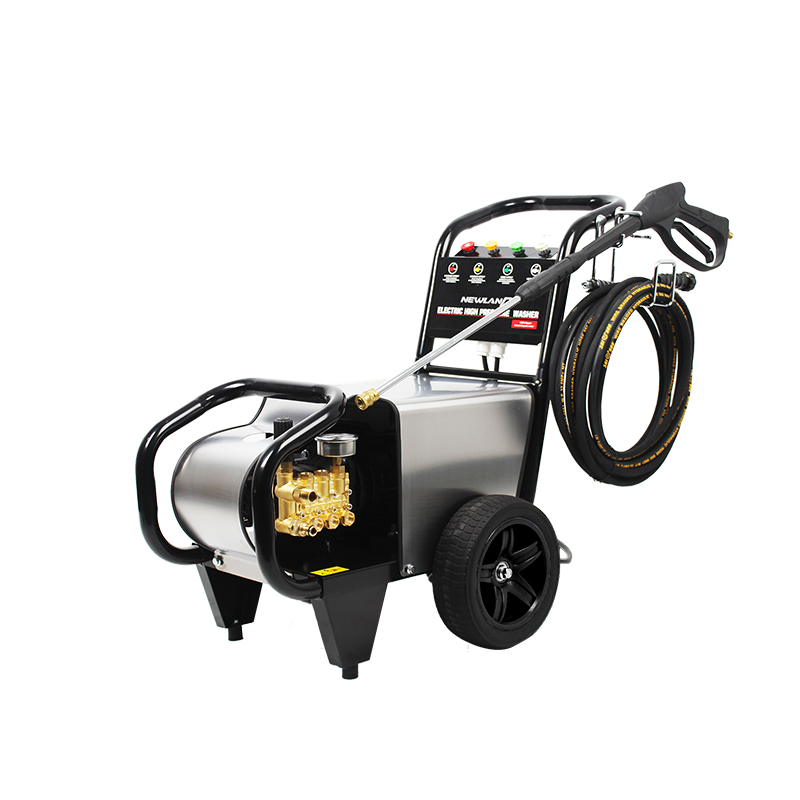
Electric pressure washers require a suitable power supply. Their output depends on motor power, voltage, pump design, and the electrical circuit available at the job site.
They can be suitable for locations with reliable electricity, including workshops, maintenance areas, and some commercial cleaning environments.
Before purchasing, confirm:
Available voltage and frequency.
Required current and electrical connection.
Motor power.
Rated working pressure and water flow.
Whether the power supply meets the manufacturer's requirements.
NEWLAND offers electric pressure washer models in different power configurations. Buyers can review the electric pressure washer range and compare the specifications of individual models.
Gasoline pressure washers are useful when operators need mobility and do not want to depend on an electrical outlet.
They can support outdoor cleaning, vehicle washing, property maintenance, and other applications, depending on the model's pressure and flow specifications.
When comparing gasoline models, check engine power, pump specifications, rated pressure, maximum pressure, water flow, fuel capacity, and starting system.
Diesel pressure washers are often considered for demanding outdoor and industrial cleaning tasks. They can operate without an external electrical power supply, making them suitable for construction sites, farms, equipment yards, and other remote locations.
For example, NEWLAND's DE200A and DE250A models have rated pressures of 200 bar and 250 bar, respectively. Their maximum flow rates are 12.6 L/min and 15 L/min. Buyers should compare the rated and maximum figures in the model specifications before making a selection.
Explore the NEWLAND diesel high pressure washer range for model details and application information.
A pressure washer needs an adequate water supply. If the incoming flow is insufficient, the pump may not receive enough water to operate as intended.
This can lead to unstable operation, overheating, or pump damage. Buyers should check the available water supply before selecting a high-flow machine.
A bucket test provides a simple estimate of the water supply flow rate.
Prepare a bucket with a known capacity.
Connect the water supply hose or open the intended water outlet.
Turn on the water fully.
Measure how long it takes to collect a known volume of water.
Calculate the flow rate using the formula below.
GPM = Water Volume (gallons) ÷ Filling Time (minutes)
For example, if a 5-gallon bucket takes one minute to fill, the measured supply flow is 5 GPM.
If it takes two minutes, the flow rate is 2.5 GPM.
The available supply should meet the pressure washer manufacturer's water-inlet requirements. Allow a suitable margin rather than choosing a machine that uses the entire measured supply capacity.
Also check the inlet hose, filter, connectors, and water source for restrictions. A clean filter and suitable hose size help maintain consistent water delivery.
Some high-flow commercial cleaning setups use a buffer tank to provide a temporary water reserve. The tank receives water from the site supply, while the pressure washer draws water from the tank.
This arrangement may help when the incoming water supply cannot continuously meet the machine's demand. However, tank capacity, inlet flow, pump requirements, filtration, and installation design must be considered together.
A buffer tank is not automatically required for every commercial pressure washer. Follow the equipment manufacturer's water-supply recommendations.
There is no single PSI and GPM combination suitable for every cleaning job. Use the following factors to narrow down your options.
Selection Factor | What to Check |
|---|---|
Cleaning task | Type and amount of dirt to remove |
Surface material | Maximum suitable pressure for the surface |
Required cleaning speed | Area size and expected rinsing time |
Water supply | Available inlet flow and pressure |
Power source | Electricity, gasoline, or diesel |
Accessories | Nozzles, hoses, and surface cleaner compatibility |
Operating conditions | Indoor or outdoor use, mobility, and working hours |
Before placing an order, compare the rated pressure and flow rate of each model. Confirm that the machine is suitable for your application and that the water and power supplies meet its requirements.
PSI and GPM are both important when choosing a pressure washer. PSI helps loosen stubborn contamination, while GPM supports rinsing and cleaning efficiency. Cleaning Units can provide a simple output comparison, but they cannot replace an application-based evaluation.
Start by identifying the surfaces you need to clean, the type of dirt involved, and the cleaning speed you expect. Then check the machine's working pressure, water flow, power source, and water supply requirements.
NEWLAND provides gasoline, diesel, and electric pressure washer options for different cleaning applications. Visit the pressure washer product range to review available models.
Contact NEWLAND with your cleaning application, required pressure, water flow, and order quantity. Our team can help you compare suitable models for your market.
Neither specification is universally more important. PSI affects the force used to loosen dirt, while GPM affects rinsing capacity and cleaning speed. The right balance depends on the surface, contamination, and application.
Not always. Higher GPM can improve rinsing and help clean larger areas faster, but the machine still needs suitable pressure and compatible accessories. The water supply must also provide enough flow.
Cleaning Units are calculated by multiplying PSI by GPM. They provide a basic way to compare pressure and flow together, but they do not account for every factor that affects cleaning results.
Changing the nozzle does not increase the pump's rated water flow. The pump and drive system determine the machine's flow capacity. A higher-flow setup may require a different pump and a suitable power source.
Use a bucket test to measure the available water flow. Divide the collected water volume by the filling time. Compare the result with the pressure washer manufacturer's inlet requirements and allow an adequate supply margin.


