


Views: 0 Author: Site Editor Publish Time: 2026-10-30 Origin: Site


Choosing between an inverter generator and a conventional generator depends on your power requirements, operating environment, and budget. Both types provide electricity when grid power is unavailable, but they use different technologies to produce and regulate electrical output.
An inverter generator is often preferred for sensitive electronics, lower-load operation, and applications where noise matters. A conventional generator can be a practical choice for users who need straightforward operation, higher power options, or a lower purchase cost.
However, neither type is automatically better for every application. Buyers should compare power quality, fuel consumption, noise, portability, maintenance, and total operating costs before making a decision.
This guide explains how the two generator types work and how to select the right option for home backup, outdoor activities, construction sites, and commercial power needs.
The main difference is how each generator produces and regulates AC electricity.
A conventional generator typically uses an engine-driven alternator to produce AC power directly. The engine must maintain a specific speed to supply electricity at the required frequency.
An inverter generator uses electronic power conversion. It converts the alternator's output into DC power and then converts it back into stable AC power. This process allows the engine speed to vary with the electrical load.
These designs affect power quality, fuel use, operating noise, and product configuration.
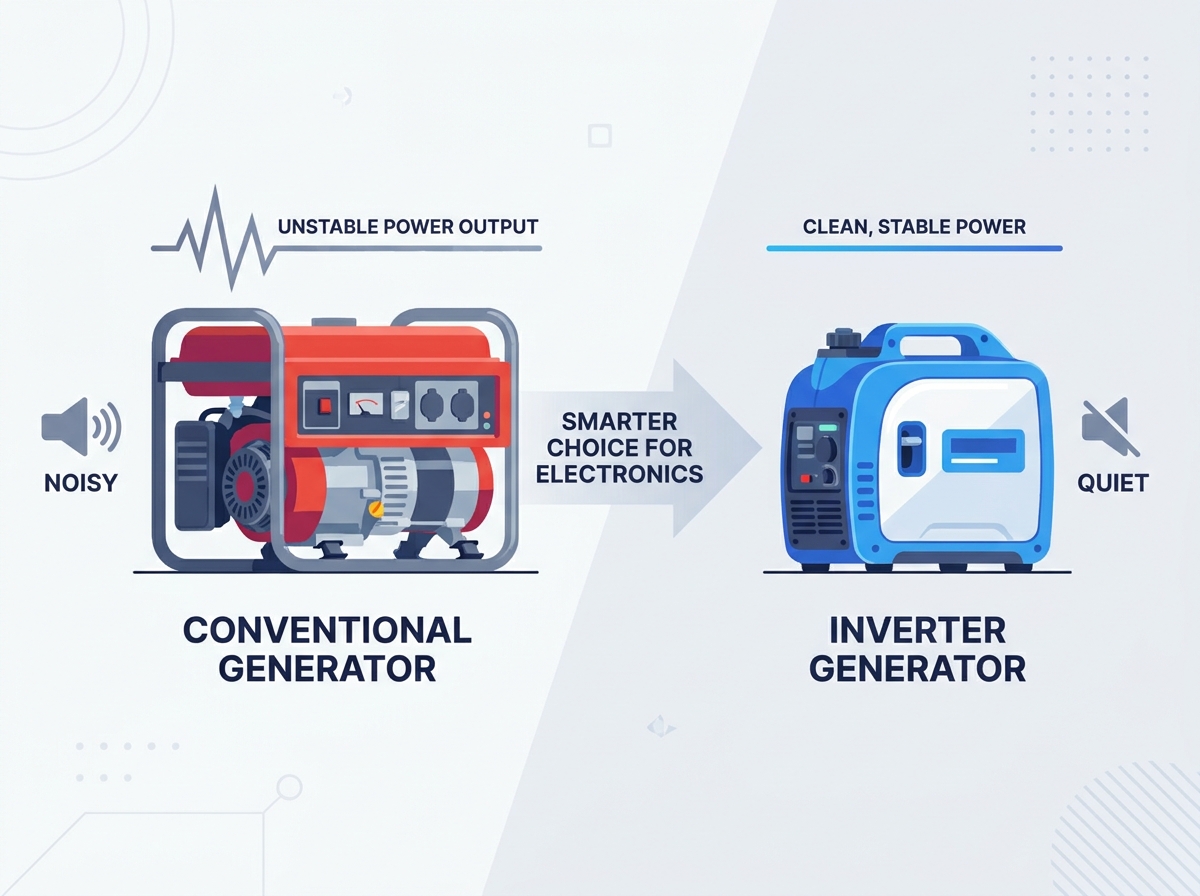
A conventional generator uses an engine connected to an alternator. As the engine rotates the alternator, the changing magnetic field produces electrical current in the stator windings.
The engine speed must remain stable to maintain the required output frequency. For example, a two-pole generator generally operates at 3,600 RPM for 60 Hz power or 3,000 RPM for 50 Hz power.
When the electrical load increases, the engine governor adjusts the throttle to maintain the required speed. If the load changes suddenly, the generator may experience temporary voltage or frequency fluctuations.
This relatively direct design is widely used in portable gasoline and diesel generators. It can provide a practical power solution for construction, workshops, agriculture, and backup applications.
An inverter generator uses an electronic power conversion system.
First, the engine drives an alternator that produces AC electricity. A rectifier converts this output into DC power. The inverter module then converts the DC power into AC electricity with the required voltage and frequency.
Because the inverter controls the final electrical output, engine speed does not need to remain fixed at the standard generator speed. The control system can adjust engine RPM according to power demand.
At lower loads, the engine can slow down to reduce fuel consumption and noise. When demand increases, the engine speeds up to supply the required power.
This design makes inverter generators suitable for applications that need stable electrical output, portable equipment, or quieter operation.
Power quality is an important consideration when connecting electronic equipment to a generator.
Total Harmonic Distortion (THD) measures how much the electrical waveform differs from an ideal sine wave. Lower THD generally indicates cleaner electrical output.
Inverter generators are designed to produce stable AC output through electronic control. Many models specify THD below 3%, making them suitable for laptops, communication equipment, televisions, and other sensitive electronics when their output ratings meet the equipment requirements.
Conventional generators use an engine-driven alternator and a voltage regulation system. Their power quality depends on alternator design, engine speed control, voltage regulation, and load conditions. Some models provide suitable output for electronic equipment, while others may have higher waveform distortion.
Do not assume that every conventional generator produces unstable power. Check the manufacturer's THD specification and voltage regulation data before connecting sensitive devices.
Fuel consumption depends on generator design, engine size, fuel type, and operating load.
Inverter generators can adjust engine speed to match electrical demand. When the connected equipment uses less power, the engine can run at a lower speed. This can reduce fuel consumption during light-load operation.
Conventional generators generally maintain a relatively constant engine speed to produce the required frequency. They may consume more fuel than an inverter model when operating under a light load.
However, actual fuel efficiency varies by model. A larger inverter generator does not automatically use less fuel than a smaller conventional generator. Compare fuel consumption or runtime at the same output level and under similar test conditions.
For buyers planning long operating hours, fuel tank capacity and runtime at a stated load are also important selection factors.
Operating noise depends on engine speed, exhaust design, enclosure structure, cooling airflow, and electrical load.
Many enclosed inverter generators are designed for quieter operation. Their variable-speed engines can reduce noise when power demand is low. Sound-insulated panels and muffler designs can further reduce operating noise.
Conventional open-frame generators often produce more noticeable engine and exhaust noise. Their engines generally maintain a fixed operating speed, even when the electrical load is relatively low.
However, not every inverter generator is quiet. Open-frame inverter models may produce more noise than enclosed models. Buyers should compare the rated noise level in dB(A), measurement distance, and operating load rather than relying on product labels such as "silent" or "super quiet."
Portability depends on rated output, engine size, fuel tank capacity, frame design, and enclosure materials.
Compact inverter generators are often designed for camping, RV use, outdoor events, and mobile work. Enclosed models may include integrated handles and compact frames for easier transport.
Conventional generators are commonly available in open-frame designs. Their steel frames provide access to the engine and alternator for inspection and maintenance. Larger models may include wheels and handles to improve mobility.
Open-frame inverter generators offer another option. They combine inverter power conversion with an accessible frame structure. This design can suit users who need stable output but also value ventilation, service access, and a more practical structure for work environments.
The available power range depends on the manufacturer's product portfolio, not simply on whether a generator uses inverter technology.
Conventional generators are available in a wide range of output capacities, including models for larger household loads, workshops, and construction equipment.
Inverter generators are also available in different power ranges. Some models are designed for small portable applications, while larger models can support more demanding power requirements.
Some inverter generators support parallel operation. When compatible models are connected using an approved parallel kit, their output can be combined to supply a larger load.
Parallel capability is model-specific. Do not assume that all inverter generators can be connected together. Check the manufacturer's instructions for compatible models, cables, and maximum combined output.
Inverter generators usually have a higher purchase price than conventional models with similar rated output. Their electronic conversion systems and, in some cases, sound-insulated enclosures add to product cost.
Conventional generators often have a simpler electrical design. Their parts and maintenance procedures may also be more familiar to technicians who regularly service small engines and alternators.
Both types require routine engine maintenance. Common tasks include checking engine oil, cleaning or replacing air filters, inspecting spark plugs, and maintaining the fuel system.
Inverter generators also contain electronic components that may require specialized diagnosis if the inverter module or control system fails. Buyers should consider local service support, spare parts availability, warranty coverage, and expected maintenance costs.
Evaluation Factor | Inverter Generator | Conventional Generator |
|---|---|---|
Power conversion | AC to DC, then back to AC | Engine-driven alternator produces AC directly |
Output quality | Generally low THD and stable output | Depends on alternator and voltage regulation |
Engine speed | Can vary with electrical demand | Usually maintains a fixed speed |
Light-load fuel use | Often more efficient | May use more fuel at light loads |
Operating noise | Often quieter, especially enclosed models | Open-frame models can be louder |
Portability | Compact models are available | Depends on frame, engine size, and output |
Power range | Available in different output capacities | Available in different output capacities |
Parallel operation | Supported by selected models | Depends on generator design |
Initial cost | Often higher | Often lower for comparable output |
Maintenance | Engine and electronic system maintenance | Mainly engine and alternator maintenance |
For home backup, start by identifying the appliances and circuits you need to operate.
An inverter generator can be suitable for essential loads such as refrigerators, routers, lighting, computers, and small appliances. Its stable output can be useful for household electronics.
A conventional generator may be more practical when you need a higher output capacity at a competitive purchase price. It can support selected household circuits and equipment when correctly sized.
Before buying, calculate both running watts and starting watts. Pumps, refrigerators, air conditioners, and other motor-driven appliances may require additional power during startup.
For fixed home backup systems, use a properly rated transfer switch and follow local electrical codes. Never connect a portable generator directly to a household outlet.
Inverter generators are often a suitable choice for camping and RV applications.
Compact models are easier to transport and store. Enclosed designs can also reduce operating noise in campsites and other shared outdoor spaces.
Stable electrical output is useful for charging devices and powering appliances with electronic controls. However, buyers must still check rated power, starting capacity, outlet configuration, voltage, and frequency.
A conventional generator may be suitable for outdoor work where noise and portability are less important than purchase cost and available output.
Conventional generators can be a practical choice for construction sites and workshops that need reliable power for tools and equipment.
Open-frame models provide access to major components and are available in different power configurations. They can support equipment such as drills, saws, lighting systems, and selected compressors when the generator is correctly sized.
Open-frame inverter generators may also suit jobsite applications where clean power is important for electronic equipment or where variable-speed operation is preferred.
Before selecting a model, check the starting requirements of motors and compressors. Also consider dust exposure, weather protection, transport requirements, and expected daily operating hours.
Agricultural and commercial users may need portable power for pumps, maintenance tools, lighting, mobile businesses, and temporary work areas.
The right generator depends on the equipment load, operating duration, fuel availability, and working environment.
A conventional generator may be suitable for users who prioritize output capacity and straightforward operation. An inverter generator can be a better fit when the application requires stable power, variable-load operation, or lower noise.
For wholesale and project procurement, buyers should also compare voltage, frequency, phase, socket configuration, starting method, and local compliance requirements.
Before placing an order, evaluate the following factors:
Calculate the required power. Add the running wattage of the equipment you plan to operate. Identify the highest starting wattage among motor-driven loads.
Check power quality requirements. Review the voltage, frequency, THD, and power-quality requirements of connected equipment.
Estimate operating hours. Compare fuel consumption and runtime at the expected load, not only the maximum rated output.
Consider the operating environment. Evaluate noise limits, ventilation, weather exposure, transport, and available storage space.
Compare maintenance support. Check spare parts availability, service access, warranty terms, and local repair capabilities.
Confirm electrical configuration. Match rated power, voltage, frequency, phase, and outlets to the target market and application.
For distributors and OEM buyers, it is also important to confirm product configuration, branding options, packaging, certification requirements, and order quantity before selecting a supplier.
There is no single winner in the inverter generator vs conventional generator comparison. Each design serves different operating requirements.
An inverter generator is often a strong option for sensitive electronics, portable applications, variable loads, and noise-sensitive environments. A conventional generator can be a practical choice for users who need straightforward operation, competitive cost per watt, or specific higher-output configurations.
The best choice depends on your equipment load, operating hours, power-quality requirements, and budget. Compare actual model specifications rather than relying on general assumptions about either technology.
If you are sourcing generators for distribution, OEM projects, or commercial applications, explore Newland inverter generators and gasoline generator solutions. Contact Newland with your required output, voltage, frequency, application, and order quantity to discuss suitable configurations.
An inverter generator converts alternator output into DC power and then back into controlled AC power. A conventional generator typically produces AC power directly through an engine-driven alternator. This difference affects engine-speed control, power quality, fuel use, and noise.
Inverter generators generally provide low-THD, stable AC output, making them suitable for many sensitive electronic devices. However, always check the generator's THD, voltage, frequency, and rated output against the equipment manufacturer's requirements.
They can use less fuel when operating under light or changing loads because the engine can adjust its speed to match power demand. Actual fuel consumption depends on the model, engine, fuel type, and load. Compare runtime at the same output level for a fair evaluation.
Yes, if its rated and starting power are sufficient for the tools. Check the starting wattage of compressors, saws, pumps, and other motor-driven equipment. Larger tools may require a higher-capacity generator.
Some inverter generators support parallel operation through a compatible parallel kit. The models must be approved for this use, and the combined output must remain within the manufacturer's limits. Not every inverter generator has this function.
No. Noise depends on engine speed, load, enclosure, muffler, and cooling design. Enclosed inverter generators are often quieter, but open-frame inverter models can still produce noticeable noise. Compare dB(A) ratings under the same test conditions.
Choose according to the appliances you need to power, their starting wattage, and your budget. An inverter generator can suit essential household loads and sensitive electronics. A conventional generator may be more suitable when you need a higher output at a lower initial cost.


