


Views: 0 Author: Site Editor Publish Time: 2026-10-30 Origin: Site


Choosing the right commercial pressure washer can improve cleaning efficiency, reduce labor costs, and limit equipment downtime. However, selecting a machine based only on its maximum pressure can lead to poor results or unnecessary spending.
Commercial buyers need to consider several factors before purchasing. These include the type of dirt, surface material, required cleaning speed, water supply, power source, operating hours, and maintenance requirements.
This guide explains how to choose a commercial pressure washer based on real working conditions. It covers PSI, GPM, cleaning units, hot and cold water systems, power sources, pump types, and equipment configurations.
Before comparing models, identify the main requirements of your cleaning operation.
Cleaning performance: Match pressure (PSI) and water flow (GPM) to the contaminants and surfaces.
Water temperature: Choose cold water for general dirt and hot water when heat can improve grease and oil removal.
Power source: Consider electric, gasoline, or diesel power based on site access, ventilation, and mobility.
Pump design: Compare direct-drive and belt-drive systems based on operating frequency and maintenance needs.
Equipment configuration: Choose a portable, skid-mounted, or stationary unit according to your worksite layout.
Operating costs: Evaluate fuel or electricity use, maintenance, spare parts, and expected service requirements.
The type of dirt determines the cleaning method and equipment requirements.
Loose dirt, mud, sand, and dust can often be removed with suitable pressure and sufficient water flow. Higher flow helps rinse away loosened debris and cover larger areas.
Oil, grease, and heavy industrial deposits may require hot water, suitable detergents, or longer cleaning time. Increasing pressure alone may not remove these contaminants efficiently.
Algae, mold, and other biological deposits may require an appropriate cleaning agent and sufficient contact time. Pressure washing should be selected carefully to avoid spreading contamination or damaging the surface.
Also consider the material being cleaned. Concrete and heavy equipment can usually tolerate more pressure than vehicle paint, wood, soft masonry, or painted surfaces.
Operating frequency helps determine the required equipment class.
Usage Pattern | Typical Application | Selection Consideration |
|---|---|---|
Occasional use | Small workshops and property maintenance | Compact equipment with straightforward maintenance |
Regular commercial use | Vehicle washing and facility cleaning | Durable components and suitable operating capacity |
Frequent heavy-duty use | Construction sites and fleet maintenance | Commercial-grade pumps, service access, and suitable power |
Extended or intensive operation | Industrial cleaning operations | Confirm the manufacturer's rated duty cycle and maintenance requirements |
Do not select a machine based only on its advertised pressure. Confirm its rated operating conditions and whether the manufacturer supports your expected working schedule.
Site conditions can limit which pressure washer is suitable.
For indoor applications, electric equipment is often a practical choice because it does not produce engine exhaust at the point of use. However, the facility must provide suitable electrical capacity, ventilation, drainage, and water access.
Outdoor and remote jobsites may require gasoline or diesel equipment when electrical outlets are unavailable. These machines must be operated outdoors or in locations that meet the manufacturer's ventilation requirements. Never operate an engine-powered pressure washer in an enclosed or poorly ventilated space.
Also check the water source. The supply must provide enough water for the machine's required flow rate. If the machine draws water from a tank, confirm that the pump supports this arrangement.
Three common specifications help buyers compare pressure washer performance: PSI, GPM, and cleaning units.
PSI means pounds per square inch. It measures water pressure and indicates the force available to remove dirt from a surface.
Higher pressure can help remove stubborn deposits, but it also increases the risk of surface damage. Excessive pressure may strip paint, damage seals, mark wood, or erode softer materials.
For this reason, select pressure according to the surface and cleaning task. Use the correct nozzle and maintain a suitable distance from the surface.
Always distinguish between working pressure and maximum pressure. Working pressure describes the pressure available during normal operation, while maximum pressure is the highest specified output. The two values should not be treated as interchangeable.
GPM means gallons per minute. It measures how much water the pressure washer delivers.
Water flow helps carry away loosened dirt and rinse large surfaces. A higher flow rate can improve cleaning speed when the water supply and accessories can support it.
Before purchasing, measure the available water supply. A simple bucket test can provide an initial estimate:
Use a container with a known capacity, such as a 5-gallon bucket.
Open the water supply fully.
Measure how many seconds it takes to fill the container.
Divide the container capacity by the filling time in minutes.
Compare the result with the pressure washer's required water flow.
For example, if a 5-gallon bucket takes 60 seconds to fill, the available flow is approximately 5 GPM.
The water supply should provide sufficient flow without starving the pump. Follow the manufacturer's inlet pressure and water supply requirements.
Cleaning units are commonly calculated by multiplying PSI by GPM:
CU = PSI × GPM
For example:
Machine A: 3,000 PSI × 4 GPM = 12,000 CU
Machine B: 2,500 PSI × 5 GPM = 12,500 CU
This calculation provides a simple way to compare pressure and flow together. However, CU is not a complete measure of cleaning performance. It does not account for water temperature, nozzle design, detergent, surface material, or operator technique.
Use CU as a preliminary comparison tool rather than the only purchasing criterion.
The following table provides general selection guidance. Actual requirements depend on the surface, contaminant, nozzle, and cleaning method.
Application | Selection Focus | Important Consideration |
|---|---|---|
Vehicle washing | Moderate pressure and suitable flow | Protect paint, seals, and trim |
Sidewalks and concrete | Sufficient pressure and higher flow | Use a suitable surface cleaner where appropriate |
Construction equipment | Higher pressure and strong water flow | Check access to water and power |
Industrial equipment | Match pressure, flow, and temperature to contamination | Confirm material compatibility and cleaning procedures |
Delicate surfaces | Lower pressure and suitable nozzle | Test a small area before cleaning |
Water temperature affects how effectively a pressure washer removes different contaminants.
Cold water pressure washers are suitable for many general cleaning tasks, including:
Removing loose dirt and mud
Washing vehicles and outdoor equipment
Cleaning patios, walkways, and building exteriors
Rinsing surfaces after detergent application
These machines have a simpler configuration because they do not require a heating system. This can reduce equipment complexity and maintenance requirements.
For contractors who mainly clean dust, mud, and general surface dirt, a cold water machine may provide sufficient performance.
Hot water can improve the removal of grease, oil, and other temperature-sensitive contaminants. Heat helps soften or loosen oily deposits, allowing detergents and water flow to remove them more effectively.
Hot water systems may be useful for:
Heavy equipment maintenance
Fleet and vehicle service areas
Industrial workshops
Food processing areas, where the cleaning procedure permits hot-water pressure washing
Surfaces contaminated with oil or grease
Hot water machines usually require additional components, such as a burner, fuel supply, heating coil, and temperature controls. These components increase the purchase price and maintenance requirements.
Before selecting a hot water system, confirm the required outlet temperature, burner fuel, heating capacity, and site ventilation.
The power source affects mobility, operating costs, noise, and installation requirements.
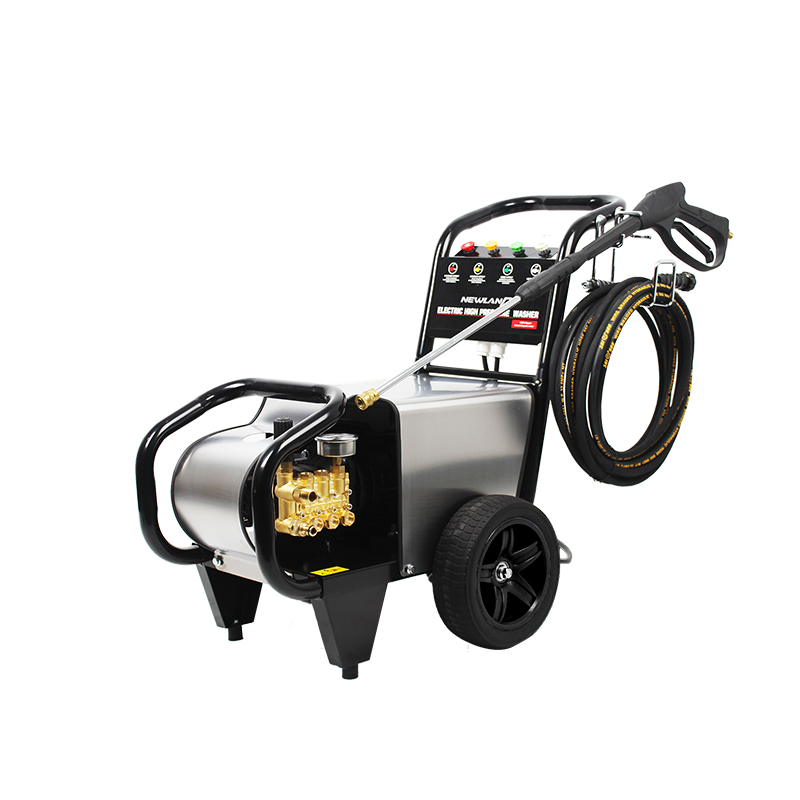
Electric pressure washers are suitable for workshops, factories, vehicle service areas, and other locations with a reliable electrical supply.
Their main advantages include:
No engine exhaust at the point of use
Lower engine-related maintenance requirements
Convenient operation in suitable indoor environments
Available configurations for different voltage and power requirements
Before purchasing, check the facility's voltage, frequency, phase, current capacity, and outlet configuration. Do not assume that a machine can operate with a standard household socket.
For example, some commercial electric models use 220V single-phase power, while higher-power models may require 380V three-phase power. Always confirm the exact model specification.
Gasoline pressure washers are useful for outdoor cleaning tasks where electrical power is unavailable or inconvenient.
They offer mobility and can support applications such as property maintenance, equipment cleaning, and construction work.
However, buyers must consider fuel handling, engine maintenance, noise, and exhaust emissions. Gasoline-powered machines must not be operated indoors or in enclosed spaces.
Diesel pressure washers are suitable for demanding outdoor and remote applications. They are often considered for construction sites, agricultural machinery, equipment yards, and fleet maintenance.
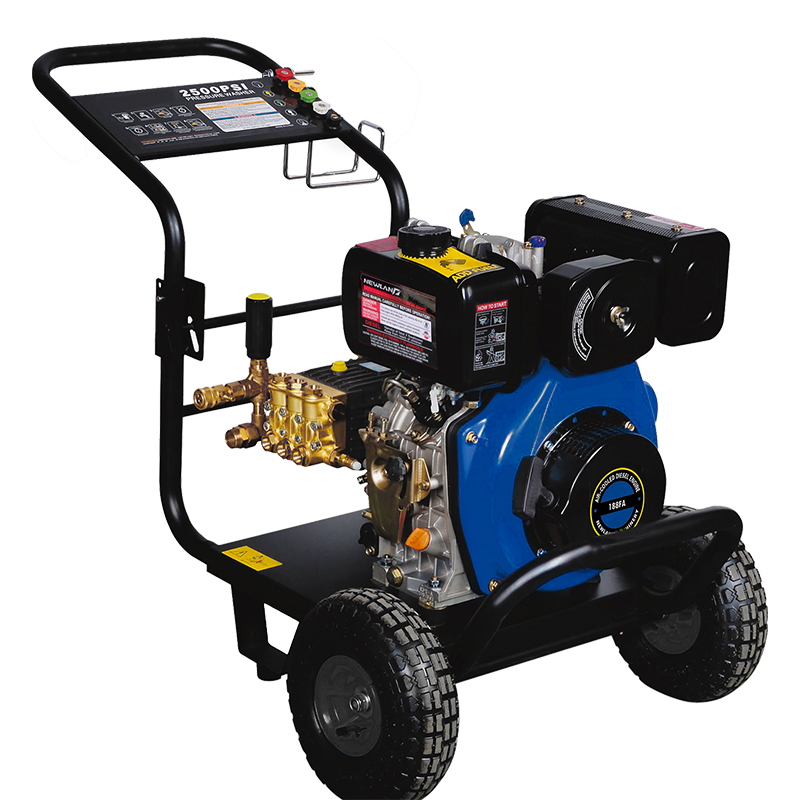
Their advantages include independent operation without an electrical connection and the ability to support demanding cleaning tasks.
When comparing diesel models, check rated pressure, maximum pressure, water flow, engine specifications, starting system, pump model, and machine weight.
For example, NEWLAND's DE200A and DE250A diesel pressure washers are listed with rated pressures of 200 bar and 250 bar, respectively. Their maximum pressures are 221 bar and 276 bar. The listed maximum flow rates vary by model. Buyers should check the model-specific technical table before selecting a unit.
Explore NEWLAND's diesel high pressure washers for outdoor and off-grid cleaning applications.
Pump drive design affects operating speed, heat, maintenance, and equipment configuration.
A direct-drive pump connects directly to the engine or motor shaft. The pump generally runs at the same speed as the power source.
Common advantages include:
Compact equipment design
Fewer drive components
Straightforward installation
Lower initial cost in many configurations
Direct-drive systems can suit portable and regular cleaning applications. However, pump speed and operating conditions must match the manufacturer's specifications.
A belt-drive system uses pulleys and belts to transfer power from the engine or motor to the pump. This allows the pump to operate at a different speed from the power source.
Potential advantages include:
More flexibility in pump speed selection
Reduced pump RPM in suitable configurations
Potentially lower operating temperature and vibration
Suitability for some frequent-use commercial applications
Belt-drive systems also require belt inspection, tension adjustment, and replacement. Their larger size and additional components may increase equipment cost.
Neither design is automatically better for every buyer. Compare the pump model, rated duty cycle, operating speed, maintenance schedule, and parts availability.
The machine's physical design affects transportation, installation, and daily operation.
Portable units are suitable for contractors and cleaning teams who move between different locations.
Check the machine's weight, wheel design, handle position, hose length, and storage requirements. A compact machine may be easier to transport, but it must still meet the required pressure and flow.
Skid-mounted systems can be installed in a truck or trailer. They are useful for mobile cleaning businesses that need to carry equipment, hoses, water tanks, and accessories together.
Before installation, calculate the total vehicle payload. Include the weight of the machine, water, fuel, hoses, and other equipment.
Water tanks can add substantial weight. The vehicle or trailer must remain within its rated load capacity.
Stationary systems are suitable for fixed cleaning areas, such as workshops, industrial facilities, and dedicated wash bays.
They can be connected to permanent water and power supplies. Depending on the installation, operators may use hose outlets at different workstations.
Professional installation may be required for electrical connections, plumbing, drainage, ventilation, and wastewater management.
A commercial pressure washer should be evaluated over its expected service life, not only by its purchase price.
Regular maintenance helps reduce unexpected downtime.
Before purchasing, ask the supplier about:
Pump oil inspection and replacement requirements
Engine oil and air filter maintenance
Inlet water filter cleaning
Nozzle and hose inspection
Seal and valve replacement
Spare parts availability
Technical support and service documentation
Hot water models also require burner, fuel system, and heating coil maintenance.
Follow the manufacturer's maintenance schedule. Do not assume that all pumps or engines use the same service intervals.
High-pressure water can cause serious injection injuries. Operators should receive proper training before using the equipment.
Important precautions include:
Wear suitable protective footwear, gloves, and eye protection.
Never point the spray gun at people or animals.
Do not use a damaged hose, gun, or fitting.
Release system pressure before maintenance.
Keep engine-powered equipment away from enclosed or poorly ventilated areas.
Follow the manufacturer's instructions for nozzle selection and operating distance.
Pressure washing can produce wastewater containing oil, grease, detergents, dirt, and other contaminants.
Before starting a project, check local wastewater discharge requirements. Some sites may need drain protection, water recovery equipment, or an oil-water separator.
Select detergents suitable for the application and permitted by local regulations. Do not assume that a biodegradable detergent can be discharged without restrictions.
The initial price is only one part of the purchase decision.
Consider the following costs:
Cost Factor | What to Check |
|---|---|
Purchase price | Machine, accessories, and installation |
Energy or fuel | Electricity, gasoline, or diesel consumption |
Water use | Water supply and disposal costs |
Maintenance | Oil, filters, seals, nozzles, and service labor |
Downtime | Repair time and spare parts availability |
Transportation | Vehicle capacity, storage, and delivery |
Compliance | Wastewater treatment and site safety requirements |
A machine with a lower purchase price may cost more to operate if it does not match the workload. Compare the expected operating costs with the cleaning output required by your business.
Before placing an order, confirm the following information:
Cleaning task: What surfaces and contaminants will the machine handle?
Pressure: What working pressure is suitable for the application?
Water flow: Can the site supply enough water for the required GPM or L/min?
Temperature: Is cold water sufficient, or is hot water needed?
Power source: Is electricity available, or is an engine-powered machine more practical?
Pump design: Does the pump support the expected operating frequency?
Configuration: Is a portable, skid-mounted, or stationary unit required?
Accessories: Are the hose, spray gun, nozzles, and surface cleaner compatible?
Maintenance: Are spare parts and technical support available?
Compliance: Do the machine and cleaning process meet local safety and wastewater requirements?
Choosing a commercial pressure washer starts with understanding the cleaning task and site conditions. PSI determines the available cleaning force, while GPM affects rinsing capacity and cleaning speed. Water temperature, power source, pump design, and equipment configuration also influence performance and operating costs.
Do not select a machine based only on its maximum pressure or advertised power. Compare the complete technical specifications and confirm that the equipment suits your actual workload.
NEWLAND offers gasoline, diesel, and electric high pressure washer options for different cleaning requirements. Buyers can compare the available pressure washer models and contact the team to discuss application requirements, model specifications, and OEM or wholesale inquiries.
The suitable PSI depends on the surface and type of contamination. Concrete and heavy equipment may require higher pressure than vehicle paint or delicate surfaces. Always check the working pressure and use the correct nozzle.
Both matter. PSI provides cleaning force, while GPM determines how much water is available to rinse away dirt. The best combination depends on the cleaning task and surface.
Cold water is suitable for general dirt, mud, and outdoor cleaning. Hot water can improve the removal of grease and oil. Choose according to the contaminants, cleaning procedure, and operating cost.
Direct-drive pumps connect directly to the engine or motor. Belt-drive systems use pulleys and belts to transfer power and can operate the pump at a different speed. Compare pump specifications and maintenance requirements before choosing.
Check the required pressure, water flow, power source, water supply, operating frequency, pump design, accessories, maintenance requirements, and wastewater rules. Confirm the full model specifications with the supplier before ordering.


