


Views: 0 Author: Site Editor Publish Time: 2026-10-30 Origin: Site


Choosing the right commercial pressure washer involves more than comparing PSI and GPM. The power source affects equipment mobility, operating costs, maintenance, noise, and job site requirements.
A diesel pressure washer can be suitable for demanding outdoor cleaning. A gasoline model offers flexible operation across different locations. An electric pressure washer can be a practical choice for workshops, industrial facilities, and other sites with suitable electrical infrastructure.
Understanding the differences between diesel vs. gasoline vs. electric pressure washers helps contractors, distributors, and equipment buyers select machines that match their cleaning applications and operating conditions.
This guide compares the three power sources and explains what to check before purchasing commercial pressure washing equipment.
Each power source has different operating requirements. The best option depends on how frequently the machine runs, where it operates, and how much mobility the job requires.
Comparison Factor | Diesel Pressure Washer | Gasoline Pressure Washer | Electric Pressure Washer |
|---|---|---|---|
Power source | Diesel engine | Gasoline engine | Electric motor |
External power required | No | No | Yes |
Mobility | Depends on machine size and weight | Generally suitable for mobile outdoor work | Depends on cable access and machine design |
Exhaust emissions | Produces exhaust | Produces exhaust | No exhaust at the point of use |
Operating noise | Engine noise | Engine noise | Generally quieter, depending on motor and pump |
Maintenance | Engine, fuel system, pump | Engine, fuel system, pump | Motor, pump, electrical components |
Suitable environments | Outdoor and remote sites | Outdoor and mobile cleaning | Sites with suitable electrical infrastructure |
Main selection factors | Workload, fuel, transport | Mobility, workload, maintenance | Power supply, output, installation |
These are general comparisons. Actual performance and maintenance requirements depend on the engine, motor, pump, equipment configuration, and operating conditions.
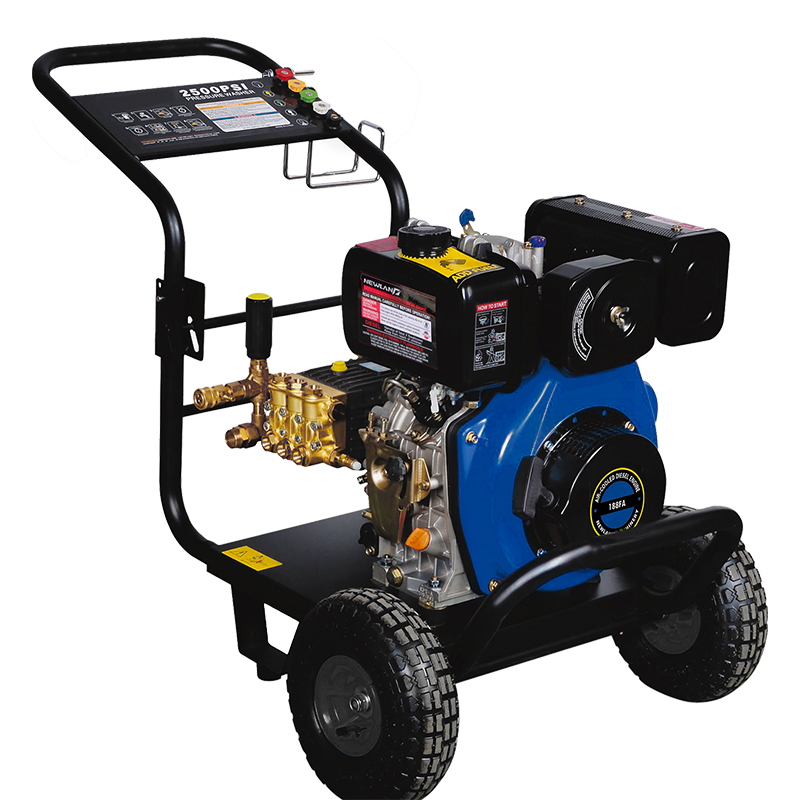
Diesel pressure washers are designed for users who need engine-powered cleaning equipment without depending on an external electrical outlet.
They can be useful for construction sites, agricultural operations, machinery yards, industrial maintenance, and other outdoor applications.
1. Independent operation
A diesel pressure washer uses an engine to drive the pump. Operators can work in locations without convenient access to mains electricity.
This makes diesel equipment useful for:
Construction and infrastructure sites.
Farms and agricultural equipment yards.
Outdoor machinery maintenance.
Remote equipment cleaning.
Commercial vehicle and fleet maintenance.
2. Options for demanding cleaning tasks
Diesel models are available in different pressure and flow configurations. Buyers should compare rated pressure, maximum pressure, and water flow to determine whether a machine can handle their cleaning requirements.
For example, NEWLAND's DE200A and DE250A diesel pressure washers provide rated pressures of 200 bar and 250 bar, respectively. Their maximum pressures are 221 bar and 276 bar. The listed maximum flow rates are 12.6 L/min and 15 L/min.
These specifications make the models relevant to buyers evaluating equipment for construction machinery, agricultural equipment, and other demanding outdoor cleaning tasks.
3. Suitable for locations without electrical infrastructure
Diesel power provides flexibility when a cleaning site has no suitable electrical connection. It can reduce the need to arrange a separate power supply for the pressure washer.
Diesel machines also involve several operating considerations:
Initial investment: The purchase price depends on engine capacity, pump configuration, and equipment design.
Equipment weight: Some models require additional handling equipment or suitable transport arrangements.
Fuel management: Buyers need to plan fuel storage, filtration, and regular maintenance.
Exhaust and noise: Diesel engines produce exhaust gases and operating noise. They require suitable outdoor operating conditions and compliance with local regulations.
Diesel should not be selected simply because it is associated with heavy-duty work. Buyers should evaluate the actual workload, required output, transport needs, and total operating cost.
<image-placeholder/>
Explore: NEWLAND Diesel High Pressure Washers
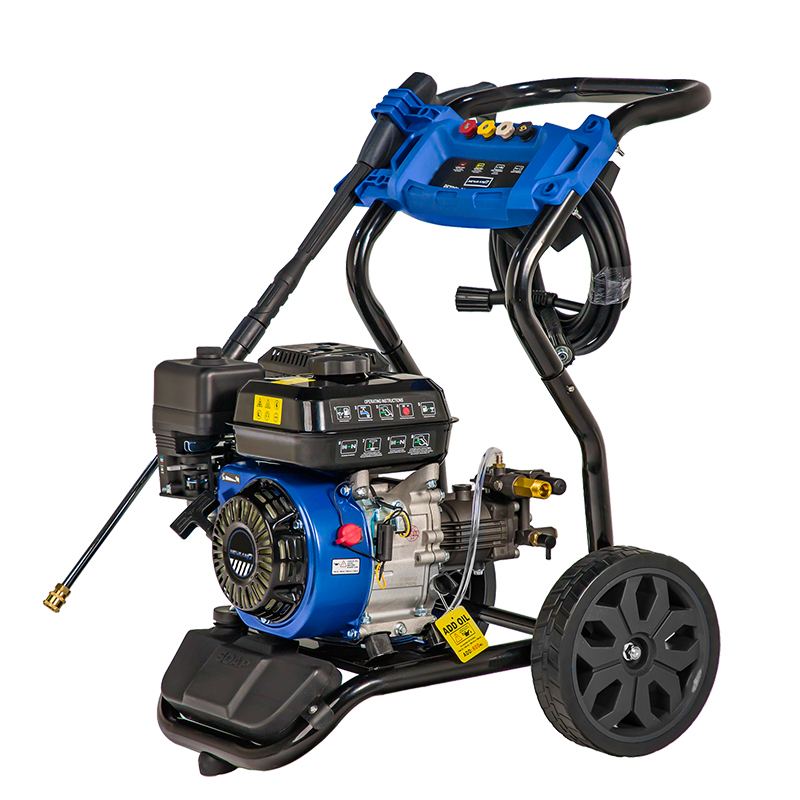
Gasoline pressure washers are widely used for outdoor cleaning where operators need independent power and equipment mobility.
They can support contractors, rental businesses, farms, workshops, and commercial maintenance teams. The available performance range depends on the engine and pump configuration.
1. Flexible operation
Gasoline-powered machines do not need an external electrical connection. This allows operators to move between outdoor work areas without relying on a fixed power outlet.
Typical applications include:
Vehicle and fleet cleaning.
Farm and agricultural equipment maintenance.
Outdoor floor and surface cleaning.
Construction site maintenance.
Workshop and property cleaning.
2. Different model configurations
Gasoline pressure washers are available with different engine sizes, pressure ratings, water flow rates, frames, and accessories.
For commercial buyers, it is important to compare the complete configuration rather than choosing a machine based on engine horsepower alone.
Check the pump type, rated pressure, maximum pressure, water flow, hose length, nozzle package, and spare parts availability.
3. Mobility for outdoor work
Many gasoline pressure washers use wheeled frames or portable structures. This can make them easier to move between cleaning areas, although actual handling depends on machine weight and frame design.
Gasoline models require routine engine maintenance and proper fuel management.
Important maintenance tasks include:
Checking engine oil and following the recommended oil change schedule.
Inspecting air filters and spark plugs.
Maintaining clean fuel and fuel filters.
Checking pump oil where applicable.
Inspecting hoses, connections, and spray accessories.
Fuel quality and storage conditions also affect engine reliability. Follow the engine manufacturer's instructions for fuel type and storage.
Gasoline engines produce exhaust gases and noise. They should not be operated in enclosed or poorly ventilated spaces.
<image-placeholder/>
Explore: NEWLAND Gasoline High Pressure Washers
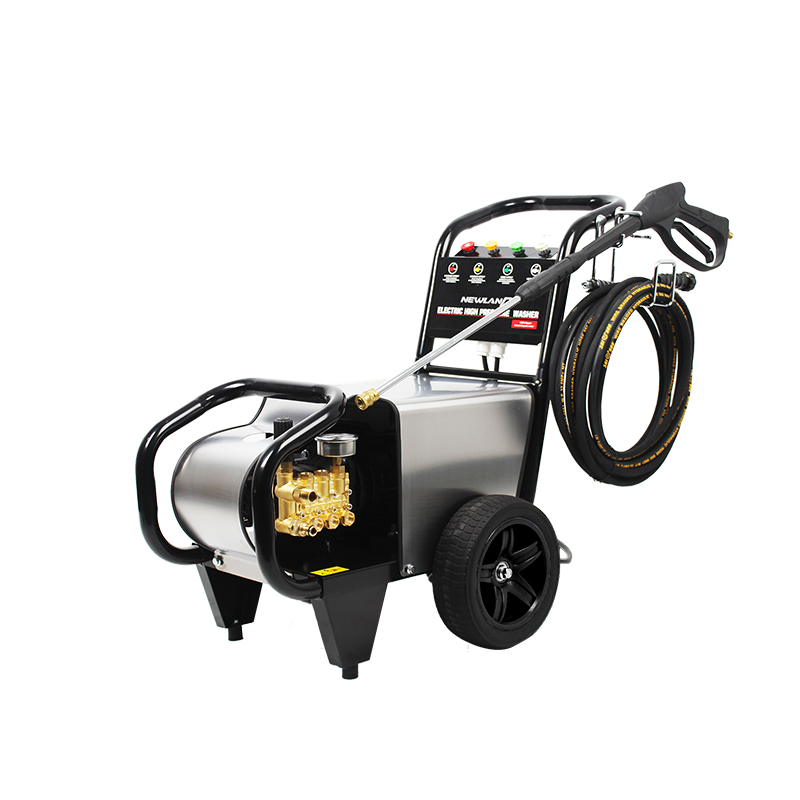
Electric pressure washers use an electric motor to drive the pump. They are often selected for workshops, maintenance areas, production facilities, and other locations with reliable electrical infrastructure.
They do not produce engine exhaust at the point of use. This can make them suitable for certain indoor cleaning applications when the electrical installation, ventilation, water management, and equipment protection requirements are properly addressed.
1. No engine exhaust at the point of use
Electric pressure washers do not use gasoline or diesel engines to drive the pump. This avoids combustion exhaust from the pressure washer itself during operation.
This can be an advantage in suitable indoor or enclosed work environments. However, the complete cleaning process must still meet site ventilation and safety requirements.
2. No engine fuel management
Electric models do not require gasoline or diesel fuel for the drive motor. Operators do not need to manage engine fuel storage or perform engine-specific maintenance such as spark plug replacement.
The pump, motor, electrical components, and accessories still require inspection and maintenance.
3. Different power configurations
Electric pressure washers are available with different motor powers and electrical requirements.
Before purchasing, confirm:
Voltage and frequency.
Required current.
Motor power.
Single-phase or three-phase connection, where applicable.
Rated working pressure and water flow.
Electrical protection and installation requirements.
A higher-output electric pressure washer may require a dedicated electrical circuit or industrial power connection. Do not assume that every commercial electric model can operate from a standard household outlet.
The main limitation is dependence on a suitable power supply.
Operators must consider cable routing, electrical connection distance, voltage drop, and protection against water exposure. Using an unsuitable extension cable can affect motor performance and create safety risks.
Electric equipment may also be less convenient when cleaning remote outdoor areas without access to electricity.
For stationary cleaning areas or facilities with suitable electrical infrastructure, however, electric pressure washers can offer a practical alternative to engine-driven models.
<image-placeholder/>
Explore: NEWLAND Electric High Pressure Washers
The right pressure washer depends on the job site and expected operating conditions. Consider the following factors before making a purchasing decision.
Start by estimating how often the machine will operate and how demanding the cleaning tasks are.
Consider:
Daily operating hours.
Frequency of trigger use.
Cleaning area and surface material.
Type of dirt and contamination.
Required pressure and water flow.
Expected maintenance intervals.
Do not assume that a machine is suitable for continuous operation simply because it is marketed as commercial equipment. Check the manufacturer's duty-cycle guidance and maintenance schedule.
Mobility requirements can significantly affect the choice of power source.
Diesel: Useful for outdoor and remote locations without convenient electrical access. Check equipment weight and transport requirements.
Gasoline: Suitable for mobile outdoor cleaning where operators move between different locations.
Electric: Practical for fixed work areas or sites where suitable power connections are available.
Also consider the machine's frame, wheel size, hose length, and available accessories.
PSI and GPM are important regardless of the power source.
PSI measures water pressure and affects the force used to loosen dirt. GPM measures water flow and affects rinsing capacity and cleaning speed.
A machine with higher pressure is not automatically more efficient. Buyers should match both specifications to the surface, contamination, and cleaning accessories.
The purchase price is only one part of the total cost of ownership.
Consider:
Cost Factor | Diesel | Gasoline | Electric |
|---|---|---|---|
Energy or fuel | Diesel consumption | Gasoline consumption | Electricity consumption |
Engine maintenance | Required | Required | Not applicable |
Motor maintenance | Not applicable to engine-driven models | Not applicable to engine-driven models | Required as specified |
Pump maintenance | Required | Required | Required |
Fuel storage | Required | Required | Not required for motor operation |
Electrical infrastructure | Not required for engine operation | Not required for engine operation | Required |
Actual operating costs depend on energy prices, machine output, workload, maintenance requirements, and local conditions.
Noise and emissions requirements vary by country, region, and work site.
Diesel and gasoline machines produce exhaust gases and engine noise. Electric pressure washers do not produce combustion exhaust at the point of use and may be preferable where engine exhaust is unsuitable.
Before purchasing, check applicable requirements for:
Outdoor and indoor equipment operation.
Carbon monoxide and ventilation safety.
Noise exposure and local noise limits.
Engine emissions regulations.
Electrical installation and equipment protection.
Never operate a gasoline or diesel pressure washer in an enclosed or poorly ventilated area. If an engine-driven machine is used outside with hoses routed indoors, the engine must remain in a location where exhaust cannot enter the building.
The pump drive system is another factor to consider when selecting a commercial pressure washer.
In a direct-drive configuration, the pump connects directly to the engine or motor shaft.
Common characteristics include:
Compact equipment design.
Fewer drive components.
Straightforward installation.
Potentially lower initial equipment cost.
The pump speed is linked to the drive speed. Buyers should check whether the pump is designed for the intended operating frequency and workload.
A belt-drive system connects the engine or motor to the pump through pulleys and belts.
Depending on the design, it can allow the pump to operate at a different speed from the engine. This may help reduce pump operating speed and provide more flexibility in equipment configuration.
However, belt-drive systems also require belt inspection, tension adjustment, and replacement when necessary.
Neither system is automatically better for every application.
Direct-drive systems can suit compact equipment and applications where their operating conditions match the pump specifications. Belt-drive systems may be considered for certain demanding commercial setups.
The correct choice depends on pump design, operating speed, expected workload, maintenance access, and manufacturer recommendations.
Regular maintenance helps protect the engine or motor, pump, and pressure washer accessories.
For diesel and gasoline models, follow the engine manufacturer's instructions for oil, filters, fuel, and service intervals.
For electric models, inspect cables, connectors, switches, and other electrical components according to the manufacturer's maintenance guidance.
Check pump oil where applicable, water inlet filters, seals, connections, and operating pressure.
An inadequate water supply or blocked inlet filter can affect pump operation. Always provide the inlet flow required by the equipment manufacturer.
When the spray gun trigger is released, many pressure washers use an unloader valve to circulate water through a bypass system.
Prolonged operation in bypass can cause water temperature to rise and may damage pump components.
Do not leave the machine running in bypass unnecessarily. Follow the manufacturer's instructions for bypass operation, thermal relief, and shutdown procedures.
Water left inside the pump, hoses, or accessories can freeze and expand in cold conditions.
Drain and winterize the machine according to the manufacturer's instructions. Use only compatible protection products and procedures recommended for the equipment.
The following recommendations provide a starting point for equipment selection.
Your Operating Conditions | Suitable Option to Evaluate |
|---|---|
Remote outdoor cleaning without mains electricity | Diesel or gasoline |
Frequent movement between outdoor job sites | Gasoline or a suitable portable diesel model |
Fixed workshop or industrial cleaning area | Electric |
Cleaning agricultural and construction machinery | Diesel or gasoline |
Indoor cleaning where engine exhaust is unsuitable | Electric, subject to site safety requirements |
Facilities with dedicated electrical infrastructure | Commercial electric |
These recommendations are not substitutes for checking individual model specifications. Always confirm pressure, flow rate, duty cycle, power requirements, and accessories before purchasing.
NEWLAND offers gasoline, diesel, and electric pressure washer ranges for different applications. Buyers can review the NEWLAND pressure washer product range to compare available options.
Diesel, gasoline, and electric pressure washers each have different advantages.
Diesel models provide independent power for demanding outdoor and remote cleaning. Gasoline machines offer flexible operation for mobile outdoor work. Electric pressure washers are practical for facilities with suitable electrical infrastructure and applications where engine exhaust should be avoided.
Before purchasing, evaluate the cleaning workload, required PSI and GPM, job site conditions, maintenance requirements, and local regulations. The best machine is the one that meets your actual operating needs without unnecessary equipment costs.
Looking for a pressure washer supplier for your distribution or commercial cleaning business? Contact NEWLAND with your application, required pressure, water flow, order quantity, and destination market. Our team can help you compare suitable gasoline, diesel, and electric models.
Neither is universally better. Diesel models can suit demanding outdoor and remote applications, while gasoline models offer flexible mobility for outdoor contractors. Compare engine specifications, pump output, workload, maintenance, and transport requirements.
Yes. Some commercial electric models provide substantial pressure and water flow. Their suitability depends on motor power, electrical supply, pump configuration, and the cleaning application. Check the rated specifications of each model.
No. Engine-driven pressure washers produce carbon monoxide and other exhaust gases. They should not be operated in enclosed or poorly ventilated areas. Electric equipment may be suitable for indoor applications when site electrical and safety requirements are met.
Direct-drive pumps connect directly to the engine or motor shaft. Belt-drive systems use pulleys and belts to connect the drive unit to the pump. Their operating characteristics and maintenance requirements depend on the equipment design.
Start with the cleaning task, surface material, required PSI and GPM, operating frequency, and job site conditions. Then compare power source, pump configuration, maintenance requirements, electrical or fuel needs, and available accessories.


